

Waikiki Rental Restrictions: Complete 2025 Guide
Did you know fines for illegal short-term rentals in Waikiki can reach $10,000 per day? Rental rules in Waikiki are complicated, and even seasoned property owners can find themselves facing major financial risks. With strict zoning, old permits, and new laws rolling out often, property investors and renters alike need a clear understanding of what’s legal and what’s not. Knowing the latest regulations helps avoid costly mistakes and protects your investment in this world-famous neighborhood.
Key Takeaways
| Point | Details |
|---|---|
| Rental Restrictions | Most short-term rentals under 30 days are prohibited in Waikiki residential zones, with a focus on compliance with local regulations. |
| Types of Rentals | Waikiki permits specific rental categories including Bed and Breakfast Homes and Transient Vacation Units, each with distinct requirements. |
| Compliance Requirements | Property owners must adhere to comprehensive registration processes including significant fees and tax registration to maintain legal compliance. |
| Penalties for Non-Compliance | Violations of rental regulations can result in substantial fines ranging from $1,000 to $10,000 per day, along with potential loss of rental privileges. |
Table of Contents
- Waikiki Rental Restrictions Defined And Explained
- Types Of Rental Terms Allowed In Waikiki
- Legal Framework And Recent Regulation Changes
- Compliance Requirements For Owners And Buyers
- Penalties, Enforcement, And Common Pitfalls
Waikiki Rental Restrictions Defined and Explained
Navigating the rental landscape in Waikiki requires understanding complex local regulations that significantly impact property owners and investors. According to research from Hawaii Living, short-term vacation rentals (less than 30 days) are generally prohibited in most residential and apartment precincts within Waikiki, with strict exceptions.
The City of Honolulu defines two primary rental categories that property owners must comprehend:
- Bed and Breakfast Homes: Requires host presence, with limited room rentals
- Transient Vacation Units: Permits whole-home rentals under specific conditions
Critical rental restrictions center around Non-Conforming Use Certificates (NUCs), which are essentially “grandfathered” short-term rental permits issued before October 1986. As documented by STR Profit Map, no new NUCs have been issued since that date, and short-term rentals remain exclusively permitted in designated resort zones like Waikiki. These permits require annual registration and renewal, making compliance an ongoing process for property owners.
For potential investors and current property owners, understanding these nuanced restrictions is paramount. Properties like Waikiki Lanais serve as prime examples where residential condo boards have strictly enforced short-term rental prohibitions, underscoring the importance of thorough due diligence before purchasing or renting out a property in this sought-after neighborhood.
 Read more about Waikiki rental guidelines to ensure you navigate these complex regulations effectively.
Types of Rental Terms Allowed in Waikiki
Waikiki’s rental landscape is tightly regulated, with specific provisions defining legal rental terms under Bill 41. According to Hawaii Living, short-term rentals are strictly limited to four distinct property categories that offer investors and property owners precise options for monetizing their real estate.
The four primary categories of legal short-term rental properties include:
- Resort Zone Properties: Specific buildings within designated Waikiki resort zones
- Non-Conforming Use Certificate (NUC) Properties: Individual units with historical rental permissions
- Grandfathered Hotels: Established properties like Aloha Surf and Waikiki Banyan
- Select Apartment-Zoned Areas: Specific A-1 and A-2 zoned locations including Waikiki Banyan and Waikiki Sunset
Here’s a side-by-side comparison of Waikiki’s primary short-term rental property categories:
| Property Type | Key Requirements | Common Examples |
|---|---|---|
| Resort Zone Properties | Located in designated resort area Registration & annual renewal | Waikiki Beach Tower Ilikai Hotel |
| Non-Conforming Use Certificate (NUC) Properties | Valid NUC issued before Oct 1986 Annual renewal | Individual approved condos |
| Grandfathered Hotels | Established before modern STR laws Hotel operations allowed | Aloha Surf Hotel Waikiki Banyan |
| Select Apartment-Zoned Areas | Specific A-1, A-2 zones Registration required | Waikiki Banyan Waikiki Sunset |
As documented by STR Profit Map, two primary short-term rental types are recognized: Bed and Breakfast (B&B) Homes, which require owner presence, and Transient Vacation Units (TVUs), permitting whole-unit rentals. Critically, all these rental types mandate comprehensive registration, annual renewal, and mandatory tax ID posting on rental listings.
Learn more about Waikiki rental strategies to navigate these complex regulations effectively.
Legal Framework and Recent Regulation Changes
Waikiki’s short-term rental landscape has undergone significant regulatory transformations, with legislative changes dramatically reshaping property owners’ rights and rental strategies. According to Hawaii Living, State Act 017 (SB 2919) marked a pivotal moment in 2024 by granting counties unprecedented authority to regulate short-term rentals’ time, place, manner, and potential phase-out mechanisms.
The legislative timeline reveals a complex evolution of rental regulations:
- 2019: Ordinance 19-18 established a 30-day minimum rental period
- 2022: Bill 22-7 attempted to raise minimum rental duration to 90 days
- December 2023: Court injunction preserved pre-existing 30-day short-term rentals
- May 2024: Act 17 expanded county regulatory powers
- September 2025: Bill 62 reinforced 90-day minimum rental requirement
As documented by HI Home Group, the September 2025 Bill 62 maintained the 90-day minimum rental duration in residential areas, though pre-existing operations retain their non-conforming use status at 30-day rentals. This nuanced approach reflects ongoing legal complexity, with enforcement mechanisms still being actively debated. Explore more about Honolulu rental regulations to stay informed about these dynamic legal changes.
Compliance Requirements for Owners and Buyers
Navigating Waikiki’s short-term rental landscape demands meticulous attention to regulatory compliance, with multiple layers of administrative requirements for property owners. According to STR Profit Map, owners must complete comprehensive registration processes that involve significant financial and administrative commitments.
Key compliance obligations include:
- Initial Registration: $1,000 fee with the Department of Planning and Permitting
- Annual Renewal: $500 ongoing maintenance fee
- Tax Registration: Mandatory General Excise and Transient Accommodations Tax registration
- Listing Requirements: Mandatory display of official tax ID on all rental listings
Property classification presents another critical consideration. As documented by Honolulu Hi5, units designated for short-term rental are categorized as ‘Hotel & Resort’ or ‘Transient Vacation’ for property tax purposes. Owners contemplating a shift to residential use can petition for reclassification, though this process may trigger potential back taxes and financial penalties. Potential buyers and investors must carefully evaluate these classification implications before making investment decisions. Discover more about Waikiki property investments to understand the full scope of these complex regulatory requirements.
Penalties, Enforcement, and Common Pitfalls
Waikiki’s short-term rental regulations come with significant financial risks for non-compliant property owners. According to Hawaii Living, Bill 41 established a robust penalty framework with fines ranging from $1,000 to a staggering $10,000 per day for violations, creating substantial financial deterrence for those attempting to circumvent rental regulations.
The potential penalties encompass multiple dimensions:
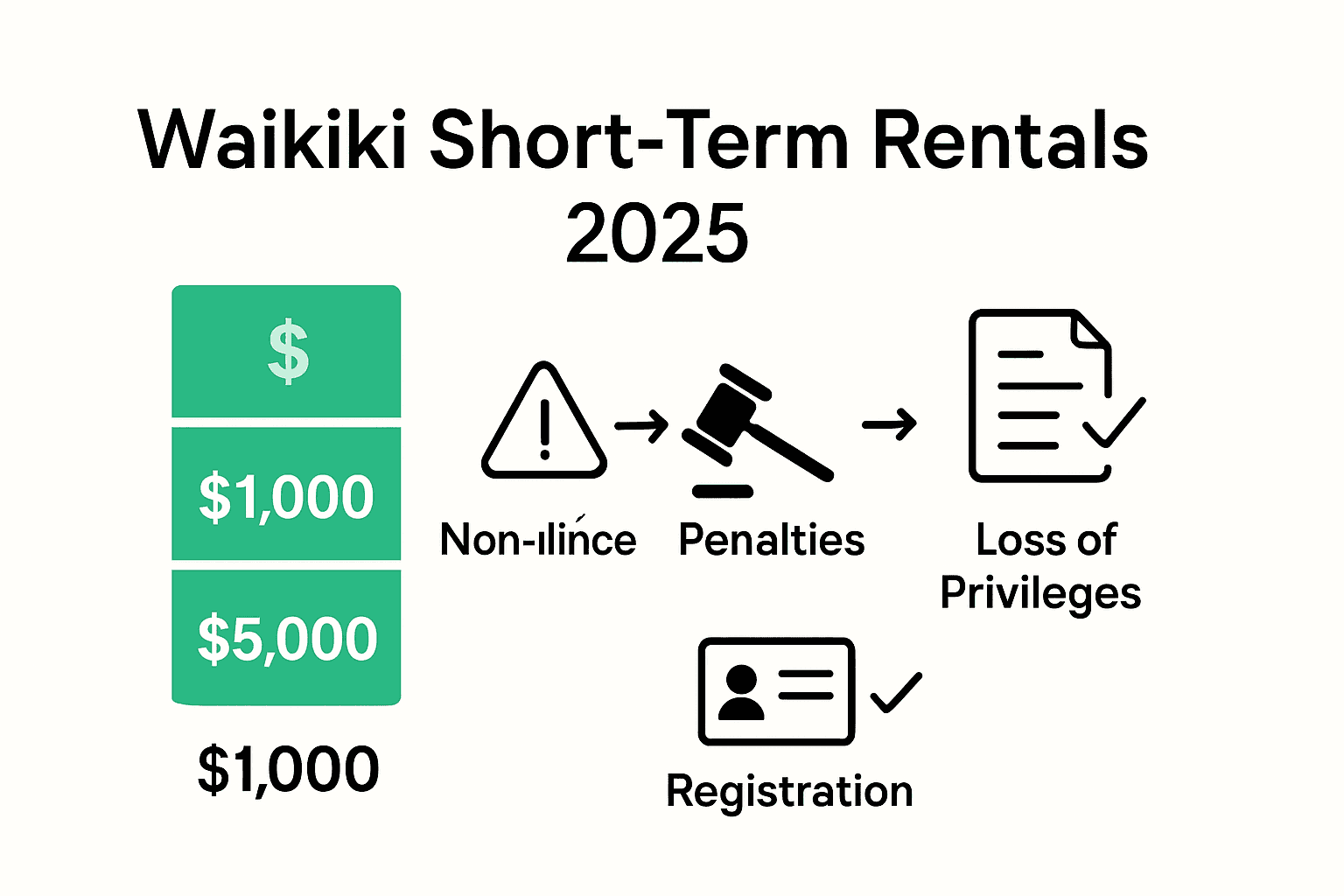
- Direct Fines: $1,000 to $10,000 daily for regulatory breaches
- Registration Penalties: $1,000 initial and $500 annual registration fees
- Potential Tax Recapture: Back taxes and additional financial assessments
- Potential Loss of Rental Privileges: Temporary or permanent rental restrictions
Interestingly, as reported by Civil Beat, enforcement remains complex. The Department of Planning and Permitting has been hesitant to aggressively penalize hosting platforms, citing legal challenges and resource constraints. This creates a nuanced enforcement landscape where many illegal short-term rentals continue to operate with limited immediate consequences. Learn more about navigating Waikiki rental regulations to understand the full spectrum of potential risks and compliance strategies.
Ready to Confidently Navigate Waikiki Rental Rules?
If Waikiki’s complex rental regulations have you feeling uncertain, you are not alone. Many buyers and investors worry about accidentally violating intricate rules around short-term rentals, Non-Conforming Use Certificates, and property classifications. We understand how important it is to feel secure in your property choices and future returns. That’s why our Vacation Rentals resource page is designed to provide up-to-date answers and clarity on the latest laws affecting your Waikiki condo purchase.
Let us help you turn confusion into confidence. At BuyOahuCondos.com, you can compare condo buildings, review rental policies, and even request a customized analysis based on your goals. Explore our investment guides to discover which condos remain compliant for short-term or long-term rental income. Reach out today to schedule your private or virtual tour. With evolving regulations, informed decisions are more important than ever—secure your Waikiki investment wisely now.
Frequently Asked Questions
What are the primary rental categories in Waikiki?
Waikiki’s rental landscape includes two main categories: Bed and Breakfast Homes, which require host presence with limited room rentals, and Transient Vacation Units, which permit whole-home rentals under specific conditions.
What is a Non-Conforming Use Certificate (NUC), and why is it important?
A Non-Conforming Use Certificate (NUC) is a permit that allows short-term rentals under grandfathered regulations established before October 1986. It is important because it represents the only way to operate a short-term rental legally in most residential areas of Waikiki.
What penalties do owners face for non-compliance with rental regulations in Waikiki?
Non-compliant property owners may face fines ranging from $1,000 to $10,000 per day, along with registration penalties, potential tax recapture, and the risk of losing rental privileges either temporarily or permanently.
What are the compliance requirements for short-term rental owners in Waikiki?
Owners must complete initial registration with a $1,000 fee, pay an annual renewal fee of $500, register for General Excise and Transient Accommodations Tax, and display their official tax ID on all rental listings.
Recommended
- Complete Guide to Honolulu Rentals 2025
- Waikiki Condominium Rentals: Complete Expertise Guide | Honolulu Condos for Sale | BuyOahuCondos.com
- Waikiki Condos for Sale | 2025 Buyer’s Guide
- Honolulu Rental Property Investment: 2025 Guide to Condos
- Understanding 2025 Travel Trends In Hawaii | Flight Of Aloha





16 Comments